ByChewie
Who Does She Think She Is, Fanny Cradock?
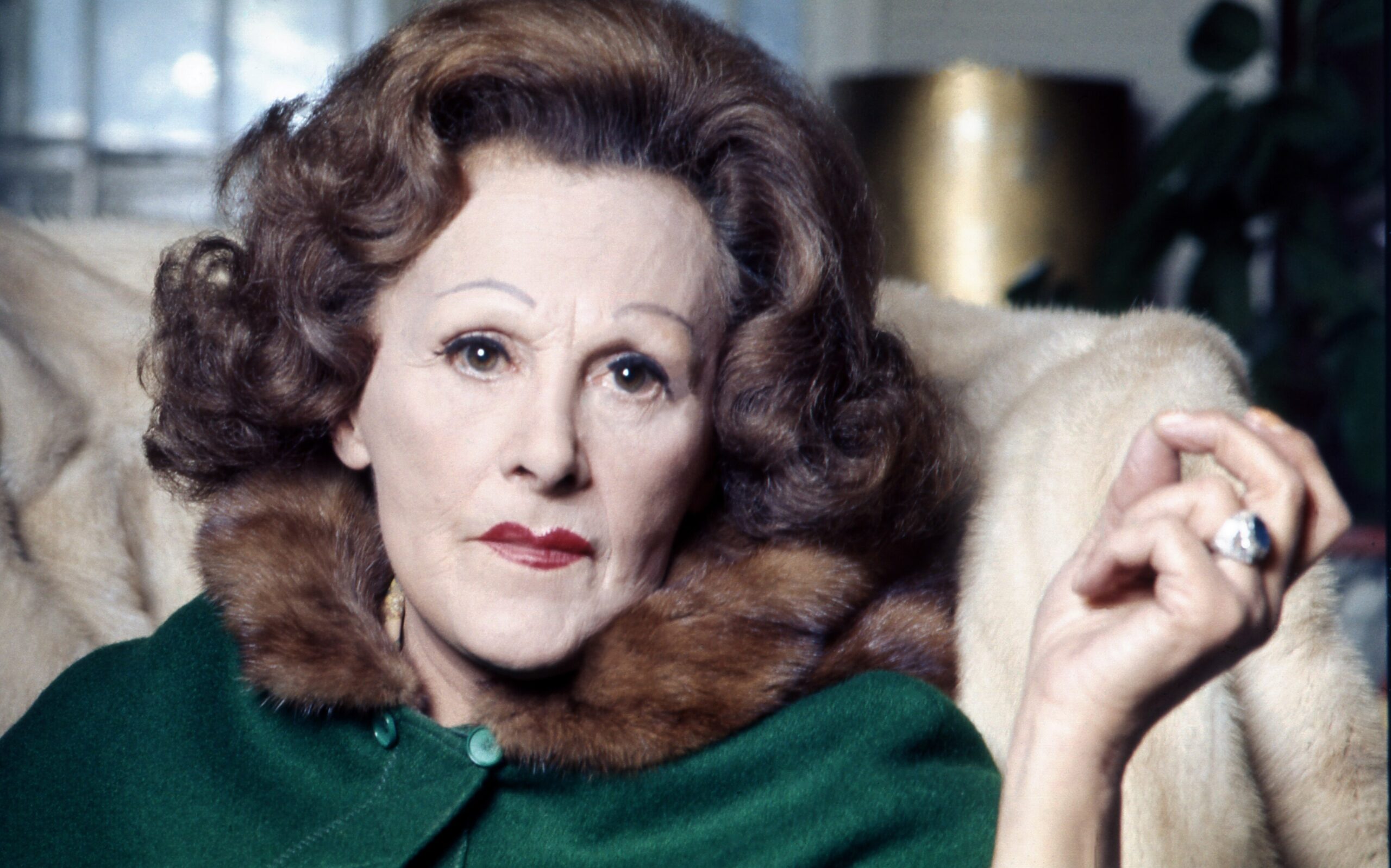
Fanny Cradock: there are very few television personalities who can make you feel like you’re in trouble within sixty seconds. Not scared — just faintly guilty. That was her gift. You don’t remember her recipes so much as her posture, her tone, her certainty. You were already failing, and she hadn’t even cracked an egg.
Fanny Cradock and the Confidence Problem
What made Fanny Cradock unsettling wasn’t simply that she was bossy or strict — plenty of television cooks have been. It was the total absence of hesitation. She moved through her kitchen with the air of someone who had never once questioned her right to be there, never paused to reconsider a decision, never entertained the possibility that she might be mistaken. Her authority didn’t feel earned so much as asserted, declared into existence and maintained through sheer force of conviction.
When she demonstrated a recipe, she wasn’t guiding viewers so much as correcting them in advance. Explanations were rare; instructions were final. Errors weren’t framed as part of learning but as evidence of personal inadequacy — a failure of discipline rather than technique. Cooking, in her world, became less a skill to be acquired and more a moral test you were quietly expected to fail.
There’s something unnerving about that kind of certainty. Confidence can be reassuring when it’s grounded in expertise, but when it floats free of doubt entirely, it starts to feel oppressive. Even her face felt costumed — those eyebrows looked like they arrived on set five minutes before she did and immediately took charge. The longer you watch her, the harder it becomes to shake the sense that this isn’t really about food at all.
The Credentials (Or the Lack of Them)
Here’s the uncomfortable truth behind all that authority: Fanny Cradock’s confidence dramatically outweighed her formal qualifications. She had no elite culinary training, no serious restaurant background, no classical French education to match the accent and airs she performed so convincingly. Her experience came from domestic science courses, newspaper columns, public demonstrations — and, crucially, an instinctive understanding of television.
What she mastered wasn’t cuisine. It was performance.
Post-war Britain was ready for someone like her. The country was emerging from rationing and disruption, hungry not just for better food but for structure, rules, reassurance that order could be restored. Fanny stepped neatly into that cultural gap, armed with posture, polish, and a voice that didn’t invite disagreement. She didn’t just offer recipes; she offered certainty. And Britain, for a long time, accepted the exchange without asking too many questions.
Confidence, after all, can sound an awful lot like competence when no one is inclined to challenge it.
The “Real” Fanny Cradock
Even her identity was a construction. She wasn’t born Fanny Cradock; she reinvented herself entirely, adopting a name, an accent, and a manner that suggested inherited authority rather than self-invention. Her husband, Johnnie Cradock, became part of the performance — less a partner than a prop, gently but persistently corrected, dismissed, and talked over on screen.
At the time, it was often read as banter. Seen now, it plays closer to ritual humiliation, repeated weekly in front of millions. This wasn’t fraud in any legal sense. It was something subtler and stranger: social cosplay, a woman casting herself as an unquestionable authority and daring anyone to challenge the role. For years, no one really did.
Patronising as a Power Move
Fanny Cradock’s patronising tone wasn’t an unfortunate side effect of her personality; it was the engine of her control. She spoke to adults the way a headmistress addresses children who have already disappointed her. Correction came before instruction. Praise was scarce and carefully rationed. Humiliation wasn’t a lapse in manners — it was instructional.
Viewers weren’t learning how to cook so much as learning how not to embarrass themselves. That’s why the reaction she provokes is still so visceral. Patronising authority doesn’t invite you into its world; it places you firmly beneath it.
The Feral Kitchen
Then there’s the cooking itself — or rather, the way she occupied the kitchen. For someone so obsessed with propriety and status, Fanny’s physical style was oddly, disturbingly, feral. She mixed cakes with her bare hands, slopped batter aggressively into tins, and attacked pans with metal spoons and forks, producing an ungodly racket that sounded less like cooking and more like reprimand.
Scrambled eggs were fought, not coaxed. Pans were scraped and punished. Noise was constant. Any competent cook knows you don’t treat eggs or cookware like that; you don’t fight food into submission. But Fanny Cradock didn’t seem to care. Tools were optional. Finesse was irrelevant. The food itself was almost incidental.
Her body became the instrument. Hands, noise, presence. Cooking turned theatrical — dominance disguised as instruction.
The Recipes (And Why They Matter)
Yes, the recipes themselves were often bizarre. Sweet and savoury collided without apology: mince omelettes dusted with icing sugar, gelatinous constructions presented as elegance. You can blame the era if you like, but plenty of people were cooking well in the seventies.
The real issue wasn’t experimentation. It was the gulf between absolute certainty and questionable results. The food rarely justified the authority with which it was delivered — but that authority was never open to debate.
When the Mask Slipped
Fanny Cradock’s downfall came when she stepped outside the tightly controlled environment of her own studio. Judging a cooking competition in Abu Dhabi in 1976, she behaved exactly as she always had — mocking contestants, humiliating amateurs, sneering at conditions — but without the indulgent framing that had once protected her.
When the footage aired, something shifted. Viewers no longer saw strict expertise; they saw cruelty. Fanny didn’t change. Television did. The BBC dropped her. Invitations stopped. The authority she had declared for decades evaporated almost overnight.
Why Fanny Cradock Still Haunts Us
Fanny Cradock wasn’t cancelled because she was harsh. She was cancelled because audiences stopped playing along. What makes her linger isn’t nostalgia or camp; it’s recognition. Everyone knows someone like her — the self-appointed baroness, the figure whose confidence far exceeds their credentials, the authority who never doubts themselves.
That’s the real discomfort. She never once wondered if she might be wrong. Watching her now, neither do we — just not in the way she intended. If Fanny Cradock has you thinking about the dark side of British television, the British dark comedy piece is the natural next stop.
Title Image credit: Photograph by Allan Warren (via Wikimedia Commons, CC BY-SA 3.0), cropped and adapted.
Chewie
Still scrolling? Then you're one of us.
Fortnightly recommendations for people whose "comfort watch" is a serial killer documentary. No spam, no filler, no cheerful nonsense.